Guide
How Thick Is a Concrete Resurfacing Overlay?
Most resurfacing overlays are 1/8 to 1/2 inch thick. Self-levelers can build deeper. Stamped overlays add another 1/4 to 3/8 inch.
The right thickness depends on the slab
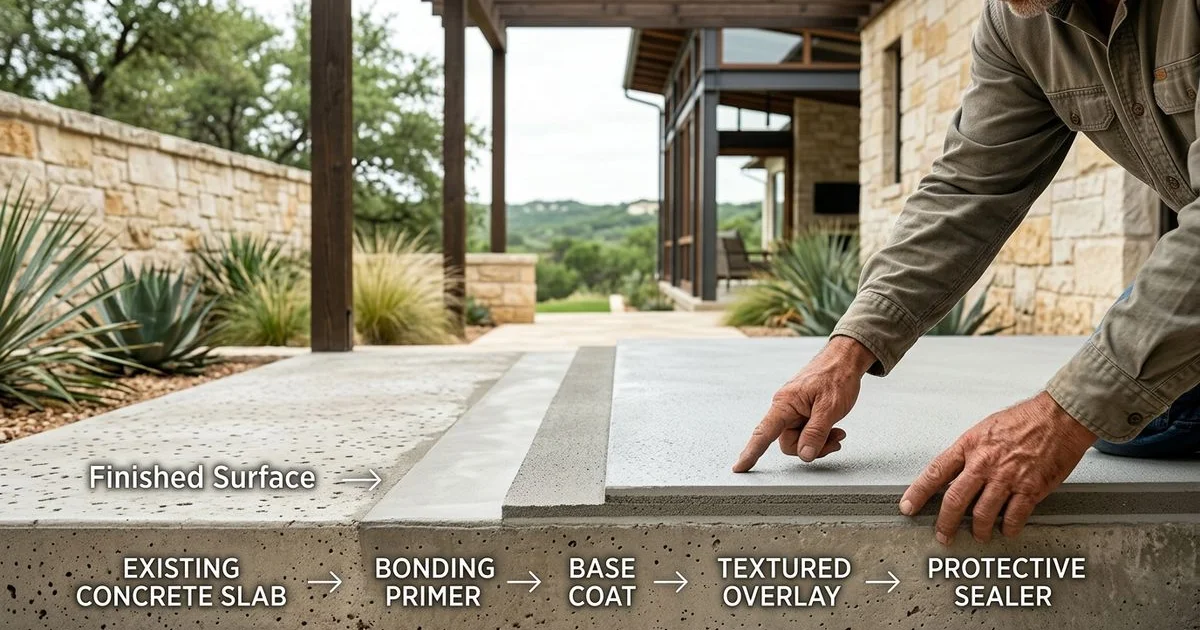
Most Concrete Resurfacing overlays sit between 1/8 inch and 1/2 inch thick. Micro-toppings start at 1/8”. Standard polymer-modified resurfacing overlays are typically 1/4” to 3/8”. Self-leveling underlayments can build to 1/2” or more where the existing slab is uneven.
Stamped overlays add another 1/4” to 3/8” on top to support the stamping pattern depth. So a stamped resurfacing on a flat slab might be 1/2” total.
Why thickness matters less than bond
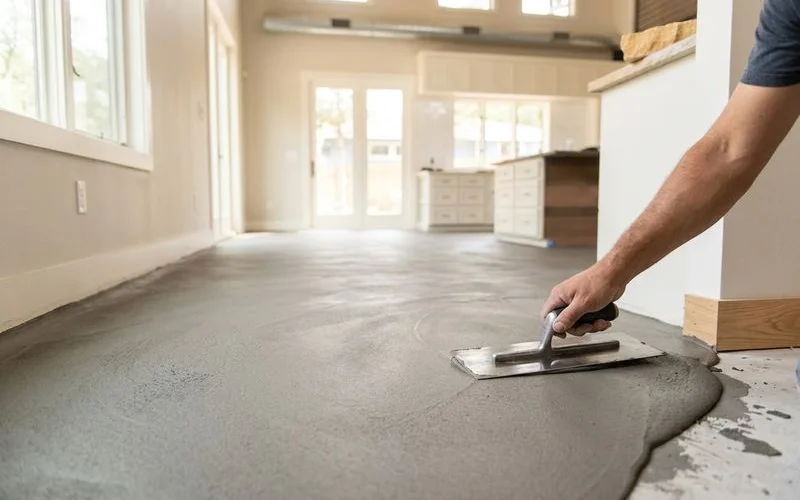
A properly bonded 1/8” micro-topping outperforms a poorly bonded 1/2” overlay every time. Bond strength comes from substrate prep — diamond grinding, the right primer, the right mix. Get those right and the overlay thickness is just an aesthetic and leveling decision.
For most projects we go thicker only when:
- The existing slab is uneven and needs a self-leveler
- A stamped pattern needs the depth to support detail
- The look calls for a more substantial-feeling surface
Otherwise thinner is fine, faster to install, and easier on thresholds.
Frequently Asked Questions
Will the thicker overlay step up onto thresholds? +
Yes, by the overlay thickness. We feather-edge at thresholds and doorways to minimize the step.
Can I do thicker than 1/2 inch? +
Yes, with self-leveling underlayments. Anything significantly thicker may need rebar or substrate prep.
Is thinner less durable? +
Not significantly. A well-bonded 1/8 inch micro-topping is as durable as a 1/2 inch overlay in foot traffic.
Related Service
Learn more about Concrete Resurfacing
Restore cracked or worn driveways, patios, and pool decks with durable overlays.
View Concrete ResurfacingRelated Guides
Can Cracked Concrete Be Resurfaced Instead of Replaced?
Usually yes — if the slab is structurally sound. Resurfacing handles surface cracks at a fraction of replacement cost.
Resurfacing vs Replacing Your Concrete
Resurface for cost and speed when the slab is structurally sound. Replace when the slab is moving or unsalvageable. Here's how to tell.
Why Central Texas Clay Soil Cracks Slabs (and the Fix)
Expansive clay moves with every wet-dry cycle. Surface cracks are inevitable. Crack-bridging overlays handle the movement without telegraphing through.