Guides
Guides
60 detailed answers to the questions Austin-area homeowners actually ask about decorative concrete.
Concrete Staining (7 guides)
Acid Stain vs Water-Based Dye for Concrete
Acid stains give variegated stone-like depth. Water-based dyes give uniform vibrant color. Each fits different aesthetic goals.
Read guide →Can Old or Stained Concrete Be Stained Over?
Usually yes — grind to clean concrete, neutralize, then stain. Heavily damaged slabs may need overlay first.
Read guide →How Long Does Stained Concrete Last and Need Resealing?
Stain itself is permanent. Sealers last 3-5 years outdoors, longer indoors. Plan reseal at those intervals to keep color sharp.
Read guide →Stained Concrete vs Stamped Concrete for Patios
Stain adds color; stamp adds pattern. For patios, the choice is between a flat color statement and a stone-look pattern.
Read guide →The Concrete Staining Process, Step by Step
Prep, neutralize, stain, neutralize, seal. The five-step staining process produces beautiful, long-lasting color.
Read guide →What Does Stained Concrete Cost in Austin?
Stained concrete in Austin runs roughly $4-$10 per square foot depending on stain type, prep needs, and sealer.
Read guide →Will Stained Concrete Fade in Texas Sun?
Quality stains with UV-stable sealer hold color through Texas sun. Cheap dyes and missed reseals fade.
Read guide →Concrete Countertops (4 guides)
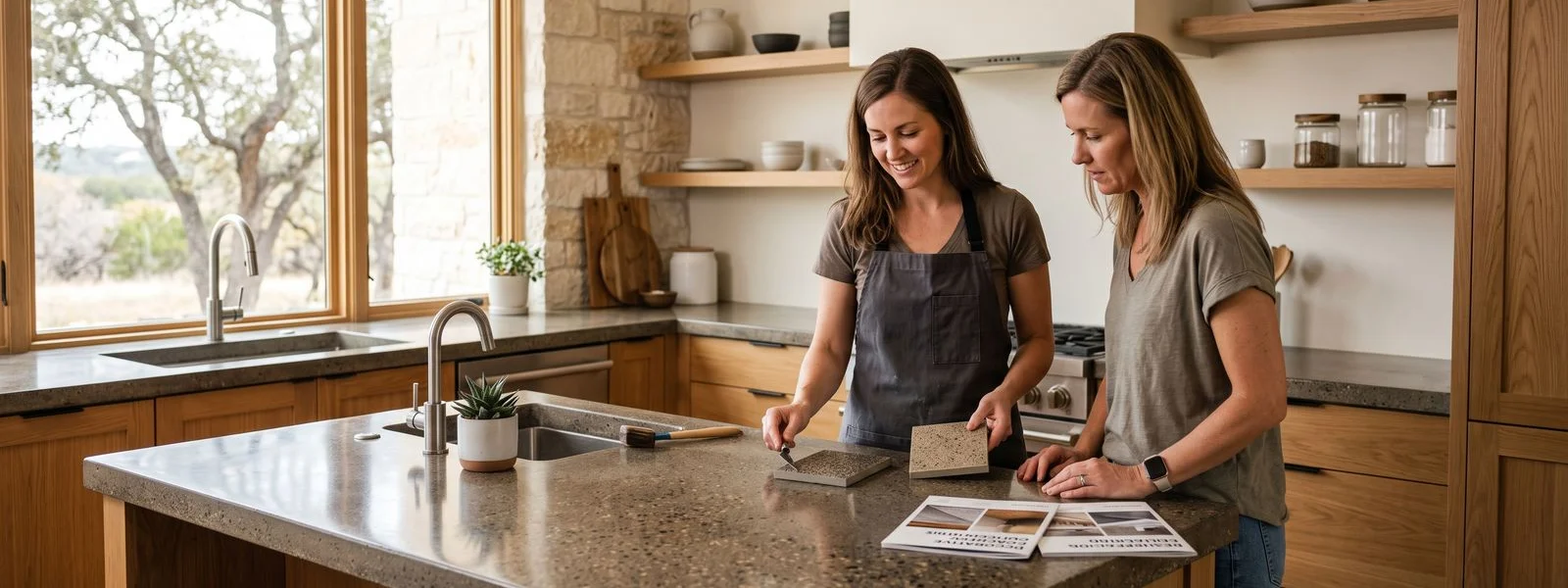
Are Concrete Countertops Durable and Stain-Proof?
Properly sealed concrete countertops are exceptionally durable and stain-resistant. Care is simple — here's what to expect.
Read guide →Concrete vs Quartz and Granite Countertops
Concrete is custom and one-of-a-kind. Quartz is consistent. Granite is natural stone. Each fits different priorities.
Read guide →Precast vs Cast-in-Place Concrete Countertops
Precast is shop-built then installed. Cast-in-place is built on-site. Each fits different countertop situations.
Read guide →What Do Concrete Countertops Cost in Austin?
Custom concrete countertops in Austin run $80-$150 per square foot, comparable to mid-tier quartz with full customization.
Read guide →Commercial Epoxy Flooring (2 guides)
Best Floor Coatings for Austin Showrooms and Shops
Polished concrete, metallic epoxy, and commercial flake systems all fit Austin showrooms. Here's how to choose by traffic and aesthetic.
Read guide →How Long Does Commercial Epoxy Take to Cure and Reopen?
Polyaspartic systems reopen in 24 hours. Standard epoxy needs 48-72. Here's the realistic timeline for keeping your business running.
Read guide →Pool Deck Resurfacing (4 guides)
Best Slip-Resistant Finishes for Austin Pool Decks
Cool-deck spray textures and overlay-with-aggregate finishes give real grip even when wet. The right pool deck finish keeps your family safe.
Read guide →Cool-Deck Spray Texture vs Polyaspartic for Pools
Cool-deck is cheaper and cooler underfoot. Polyaspartic is sealed and UV-stable. Each fits different pool deck priorities.
Read guide →How to Make a Hot Pool Deck Cooler Underfoot
Cool-deck spray textures and light-color finishes reduce pool deck surface temperature by 15-25 degrees in Texas sun.
Read guide →When Does a Pool Deck Need Resurfacing vs Repair?
Repair handles isolated cracks and spots. Resurfacing covers the whole deck for a uniform finish. Here's when each makes sense.
Read guide →Peeling Epoxy Floor Repair (3 guides)
Can a Failed Epoxy Floor Be Fixed or Must It Be Removed?
Almost always removed. Failed coatings need full grind-back before recoating. Spot fixes don't work.
Read guide →DIY Epoxy Failure vs Professional Re-Coat
DIY kits fail under Texas heat. Professional recoat uses diamond grinding and industrial chemistry. Here's the difference in practice.
Read guide →Why Is My Garage Epoxy Peeling or Bubbling?
Failed garage epoxy almost always comes from skipped prep, moisture, or DIY chemistry. Here's how to diagnose and fix it.
Read guide →Concrete Resurfacing (4 guides)
Can Cracked Concrete Be Resurfaced Instead of Replaced?
Usually yes — if the slab is structurally sound. Resurfacing handles surface cracks at a fraction of replacement cost.
Read guide →How Thick Is a Concrete Resurfacing Overlay?
Most resurfacing overlays are 1/8 to 1/2 inch thick. Self-levelers can build deeper. Stamped overlays add another 1/4 to 3/8 inch.
Read guide →Resurfacing vs Replacing Your Concrete
Resurface for cost and speed when the slab is structurally sound. Replace when the slab is moving or unsalvageable. Here's how to tell.
Read guide →Why Central Texas Clay Soil Cracks Slabs (and the Fix)
Expansive clay moves with every wet-dry cycle. Surface cracks are inevitable. Crack-bridging overlays handle the movement without telegraphing through.
Read guide →Concrete Cleaning & Sealing (2 guides)
Clean-and-Seal vs Staining: Which Does My Patio Need?
Clean-and-seal refreshes existing color. Staining adds new color. Both protect the surface. Here's how to choose.
Read guide →How Often Should Concrete Be Cleaned and Resealed?
Reseal outdoor concrete every 3-5 years. Clean as needed. Maintenance is simple — here's the timeline.
Read guide →Specialty Concrete (1 guides)
Epoxy Garage Floor Coatings (8 guides)
Do I Need to Grind My Garage Floor Before Epoxy?
Yes — diamond grinding is what gives epoxy a mechanical bond and stops the early peeling that ruins DIY garage floors in Texas.
Read guide →Epoxy vs Polyaspartic for Austin Garage Floors
Epoxy bonds and colors; polyaspartic protects and cures fast. Most Austin garages benefit from both — here's why.
Read guide →Flake Epoxy vs Solid-Color Garage Coatings
Flake systems hide imperfections and add slip resistance; solid color is simpler. See which garage floor coating fits your Austin home.
Read guide →How Long Do Epoxy Garage Floors Last in Texas Heat?
A properly prepped epoxy garage floor lasts 10-20 years in Texas. See what shortens it and how polyaspartic extends it.
Read guide →Professional Epoxy vs DIY Garage Floor Kits
Hardware-store kits are 1-part epoxy with acid-etch prep. Pro systems are 2-part epoxy on diamond-ground concrete. Different floors, different lifespans.
Read guide →What Does an Epoxy Garage Floor Cost in Austin?
Professional epoxy garage floors in Austin run roughly $5-$10/sq ft for industrial systems. Slab condition, finish, and topcoat drive the range.
Read guide →What Is Hot-Tire Pickup and How Is It Prevented?
Hot-tire pickup is when a parked tire pulls coating off the floor. The fix is industrial prep, the right primer, and a polyaspartic topcoat.
Read guide →Will Epoxy Hide Cracks and Stains in My Garage Slab?
Properly prepped epoxy hides minor surface cracks and old oil stains. Major cracks need repair first — here's how to tell the difference.
Read guide →Epoxy Flooring (3 guides)
Epoxy Flooring vs Polished Concrete for Interiors
Epoxy is a coating on top; polished concrete is the slab itself. Both work indoors. Here's how to pick.
Read guide →How Long Does an Epoxy Floor Installation Take?
Most residential epoxy installs take 2-3 days. Polyaspartic systems can be done in 1 day. Here's the realistic timeline.
Read guide →Is Epoxy Flooring Good for Interior Living Spaces?
Yes — modern epoxy systems work beautifully in interior living spaces. The key is matching resin to room and finishing for the look you want.
Read guide →Cracked Concrete Repair (2 guides)
How Clay-Soil Slab Movement Causes Cracks in Austin
Central Texas expansive clay moves with every wet-dry cycle. Surface cracks are the symptom. Crack-bridging finishes handle it.
Read guide →Which Concrete Cracks Can Be Repaired vs Replaced?
Hairline and stable surface cracks repair fine. Widening or structural cracks need foundation work first.
Read guide →Polished Concrete (8 guides)
How Long Does a Polished Concrete Floor Last?
Polished concrete lasts 20+ years residentially and 10-20 years commercially. The slab is the finish — there's no coating to fail.
Read guide →Is My Existing Slab a Good Candidate for Polishing?
Most slabs polish well. Old, contaminated, or extremely cracked slabs may need overlay first. Here's how to tell.
Read guide →Is Polished Concrete Slippery or Hard to Maintain?
Polished concrete is no slipperier than tile and easy to maintain with neutral cleaner and occasional reseal.
Read guide →Polished Concrete Cost per Square Foot in Austin
Polished concrete in Austin typically runs $5-$12 per square foot. Gloss level, slab condition, and dye drive the range.
Read guide →Polished Concrete Gloss Levels Explained
From satin matte to mirror gloss, polished concrete comes in distinct gloss levels. Here's how they look and where each fits.
Read guide →Polished Concrete vs Epoxy Floor Coating
Polished concrete is the slab itself; epoxy is a coating on top. Both last decades. Here's the decision framework.
Read guide →Polished Concrete vs Stained Concrete
Polished is mechanical refinement. Stained is chemical color. Often combined — polished-and-stained gives both.
Read guide →What Is Polished Concrete and How Is It Done?
Polished concrete is the slab itself, mechanically ground through a grit progression to a finished surface. Here's the full process.
Read guide →Stamped Concrete & Overlays (3 guides)
How Stamped Overlays Mimic Stone, Brick, and Wood
Stamp mats press patterns into wet polymer-modified overlays, then color and antiquing agents create realistic stone, brick, or wood looks.
Read guide →Stamped Overlay vs Stamped (Poured) Concrete
Overlays stamp over existing slabs. Poured stamps go in fresh concrete. Both look great — here's how to choose.
Read guide →Will a Stamped Overlay Get Too Hot for a Patio?
Light-color stamped overlays with the right sealer stay barefoot-friendly. Dark colors get hot — choose wisely for Texas patios.
Read guide →Metallic Epoxy Floors (3 guides)
Metallic Epoxy vs Standard Flake Epoxy
Metallic is the designer choice; flake is the workhorse. Both use the same chemistry — the difference is finish and effect.
Read guide →What Is Metallic Epoxy and How Is the Look Created?
Metallic epoxy combines reflective pigments with epoxy resin, then moves them with tools to create marble- and lava-like effects.
Read guide →Where Do Metallic Epoxy Floors Work Best?
Metallic epoxy shines in spaces with overhead lighting that catches the depth — garages, showrooms, restaurants, and feature interior rooms.
Read guide →Concrete Overlays & Micro-Toppings (2 guides)
Micro-Topping vs Self-Leveling Overlay
Micro-toppings are 1/8 inch and follow the slab. Self-levelers are deeper and flatten unevenness. Here's when to use each.
Read guide →What Is a Micro-Topping and Where Is It Used?
Micro-topping is a thin 1/8 inch polymer-modified overlay. Used for fresh interior and exterior finishes over sound existing concrete.
Read guide →Polyaspartic Coatings (3 guides)
Polyaspartic vs Epoxy: Which Lasts Longer Outdoors?
Polyaspartic wins outdoors. Standard epoxy yellows and breaks down under UV. Here's the realistic outdoor lifespan of both.
Read guide →What Is a Polyaspartic Coating?
Polyaspartic is an aliphatic polyurea that cures fast, blocks UV, and resists abrasion. The decorative coating built for outdoor concrete.
Read guide →Why Polyaspartic Holds Up to Texas UV and Heat
Aliphatic polyurea chemistry keeps polyaspartic color-stable under Texas sun. Here's the science and what it means for your floor.
Read guide →Have a Project? Skip Straight to a Free Quote
Guides are great, but a phone call or photo gets you a real number, fast.
Get a Free Quote