Guide
How Long Do Epoxy Garage Floors Last in Texas Heat?
A properly prepped epoxy garage floor lasts 10-20 years in Texas. See what shortens it and how polyaspartic extends it.
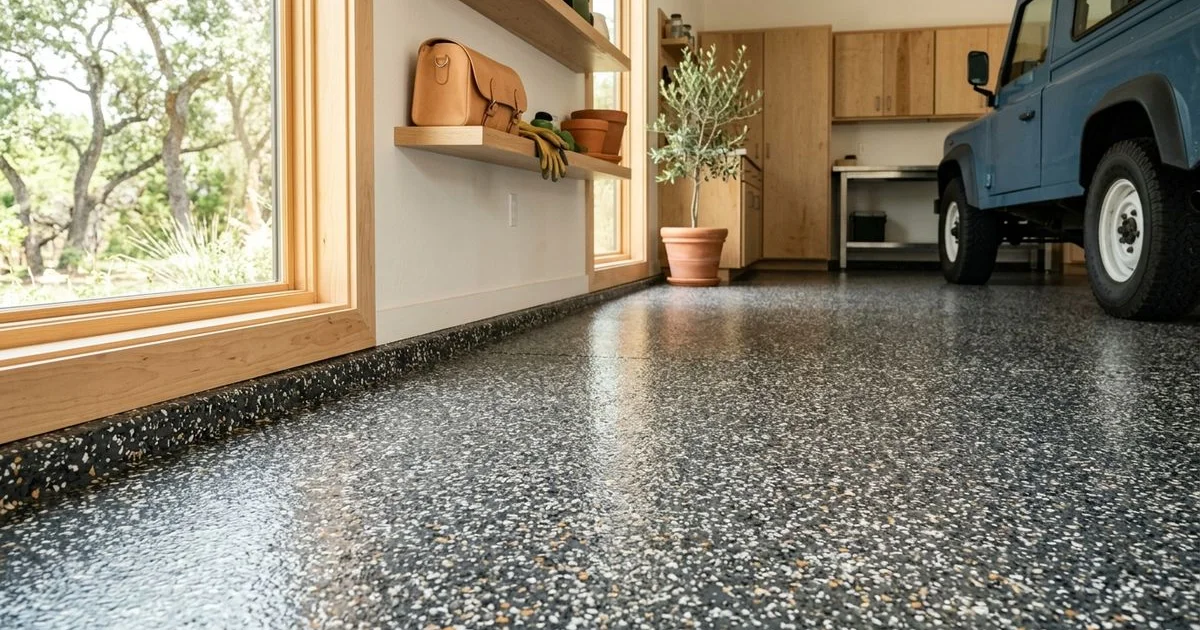
What 10 to 20 years really looks like
A properly prepped industrial-grade epoxy garage floor lasts 10 to 20 years in Texas. The range depends on three things: how well the slab was prepped, whether the system includes UV protection, and how the floor gets used (one daily-driver versus a four-bay workshop matters).
The most important variable by a wide margin is prep. We’ve seen 25-year-old epoxy floors that still look near-new — every one of them got proper Epoxy Garage Floor Coatings with full diamond grinding and a polymer-modified primer before color went down. The cheap path (acid etch on a single-part epoxy) rarely makes it past two summers.
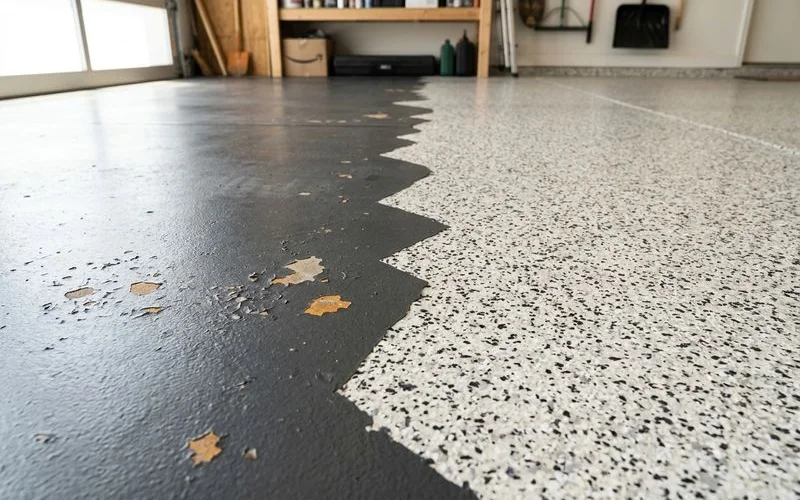
What shortens it (and what helps it last)
Three things shorten the life of an Austin garage floor: poor prep, UV exposure, and moisture coming up through the slab. Poor prep is the killer. Without a CSP 2 to 3 surface profile, the coating has nothing to bond mechanically to — hot tires lift it, doors tug at it, the heat does the rest.
UV is the second issue. Standard epoxy yellows under sun, especially through big garage doors. The fix is a polyaspartic topcoat that blocks UV without yellowing. Polyaspartic is technically aliphatic polyurea — it cures fast, stays color-stable, and adds real abrasion resistance.
Moisture is third. A slab on grade with no vapor barrier (very common in older Austin homes) can drive moisture up through the floor and lift the coating from below. A calcium chloride test before install tells you if you need a moisture-mitigation primer.
How polyaspartic extends lifespan
A flake-epoxy basecoat with a clear polyaspartic topcoat is the most durable garage system we install. The basecoat delivers color and a mechanical bond to the slab. The topcoat blocks UV, resists abrasion, and stays color-stable for the full life of the floor. We’ve put down polyaspartic-topped systems that are still showroom-clean 12+ years later in West Lake Hills, Lakeway, and across the metro.
The other reason polyaspartic helps: it cures in hours rather than days, which lets us complete a full system in a single workday and have you parking on the floor within 24 hours.
Done right, with proper prep and a UV-stable topcoat, a Texas garage floor has no real reason to fail before year 15.
Frequently Asked Questions
Does Texas heat shorten epoxy floor life? +
Heat alone doesn't shorten well-prepped industrial epoxy. UV does — which is why polyaspartic topcoats matter for any garage with direct sun exposure.
What makes an epoxy floor fail early? +
Skipped diamond-grinding prep, moisture in the slab, big-box DIY kits, and acid-etch shortcuts. Address all four and the floor easily reaches 15 to 20 years.
Can you re-coat an old epoxy floor? +
Yes — after diamond-grinding back to sound concrete and addressing whatever caused the original failure.
Related Service
Learn more about Epoxy Garage Floor Coatings
Industrial-grade flake epoxy systems that resist hot tires, chemicals, and Texas heat.
View Epoxy Garage Floor CoatingsRelated Guides
Do I Need to Grind My Garage Floor Before Epoxy?
Yes — diamond grinding is what gives epoxy a mechanical bond and stops the early peeling that ruins DIY garage floors in Texas.
Epoxy vs Polyaspartic for Austin Garage Floors
Epoxy bonds and colors; polyaspartic protects and cures fast. Most Austin garages benefit from both — here's why.
Flake Epoxy vs Solid-Color Garage Coatings
Flake systems hide imperfections and add slip resistance; solid color is simpler. See which garage floor coating fits your Austin home.
Professional Epoxy vs DIY Garage Floor Kits
Hardware-store kits are 1-part epoxy with acid-etch prep. Pro systems are 2-part epoxy on diamond-ground concrete. Different floors, different lifespans.